IT-based ASEAN+3 Food Security Cooperation and Support for Capacity Building
IT-based ASEAN+3 Food Security Cooperation and Support for Capacity Building□ As a means to stabilize supply and demand of food, especially rice and its price within the ASEAN region, the nine ASEAN countries have established the AFSIS(ASEAN Food Security Information System) since 2001 and brought the agenda to the APEC Summit. Despite such active efforts, however, the countries have not yet found an effective solution and they are seeking for solutions to fundamentally overcome the food crisis caused by imbalance of food supply and demand from climate change or natural disasters in ASEAN countries.
□ The National Information Society Agency(hereinafter, NIA) of the Republic of Korea, in a bid to improve food security in the region, has been carrying out the project titled ‘IT-based ASEAN+3 Food Security Cooperation and Support for Capacity Building(hereinafter, ASEAN+3 project)’ from August 2017 to July 2018 with the ASEAN+3 Special Cooperation Fund, followed by funded by ASEAN+3, followed by the project titled ‘Assessment of ASEAN Food(rice) Trade System and Development of IT-based Food(rice) Trade Model’ from May 2013 to April 2014 with the ASEAN-Korea Cooperation Fund.
□ The ASEAN+3 project is aimed at improving ASEAN+3’ ability to respond to food security issues by (1) research and analysis of 5 ASEAN countries and development of a regional framework for rice data collection and management, (2) development of an ‘ASEAN+3 Rice Supply and Demand Model’, (3) research of operational issues related to the model, and (4) capacity building workshops for working-level and higher-level officials.
□ For analysis of rice data collection and management in the 5 countries, the NIA delegation has been going on a study tour of Philippines, Malaysia, Brunei, Singapore and Indonesia from February to May 2018. In February, the delegation visited National Food Authority, Philippines Statistics Authority of the Philippines and other stakeholders, and studied the rice data collection and management scheme including various rice data produced through the rice value chain, laws and regulations on rice data management, rice trade process, and the status of IT infrastructure and environment, etc.
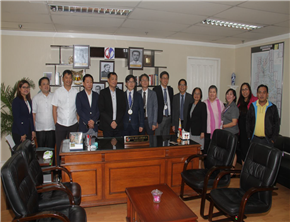
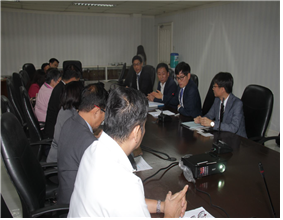
Meeting with National Food Authority of the Philippines (Manila, Philippines, February 2018)
□ For development of an ‘ASEAN+3 Rice Supply and Demand Model’, the initial studies were carried out in 2014 for Thailand, Cambodia, Laos, Myanmar and Vietnam, and this project will cover all ASEAN countries + 3 with further study from March to June 2018. The Model would be a dynamic, simultaneous, policy-specific partial equilibrium model that forecasts the rice supply and demand each year using the previous year’s solution, derives the equilibrium price when total supply is equal to total demand, incorporates policy measures allowing simulation, and is easy to maintain and update. It will cover the 10 ASEAN countries + 3 as well as information on world rice prices, macroeconomic assumptions and more. It uses the production, supply and distribution data of USDA/FAS; production, harvested area, crop yield data of AFSIS, producer prices data of FAO, and other macroeconomic variables and policy data.
□ Next, NIA is supposed to organize two ‘Capacity Building Workshops on ASEAN+3 Rice Trade Forecast Model for ASEAN+3 officials’, one for working-level officials and the other for high-level officials, with the support of the ASEAN Food Security Information System (AFSIS). The workshop for ASEAN+3 working-level officials was held from 6 to 10 November 2017 in Seoul, Republic of Korea. The workshop was aimed at introducing the ASEAN+3 Rice Supply & Demand Forecast Model, seeking for ways for development, and offering opportunities to share the rice data collection and management schemes of the ASEAN+3 countries and to learn digital technologies and policies for agriculture, best practices and ODA strategies. The workshop for ASEAN+3 high-level officials are planned to be held in June 2018.
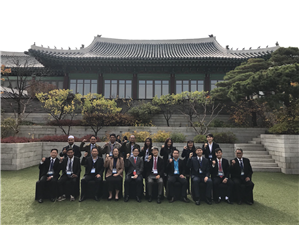
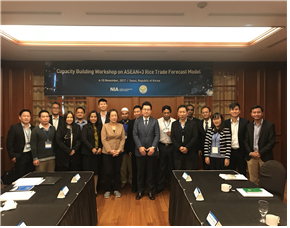
‘Capacity Building Workshops on ASEAN+3 Rice Trade Forecast Model for ASEAN+3 working-level officials’ (Seoul, the Republic of Korea, November 2017)
□ Overall, this project will help improve the ASEAN+3 countries’ ability to respond to food security issues and strengthen a mutual assistance system among the member countries by sharing knowledge on how to understand and operate a ‘ASEAN+3 Rice Trade Model’. Especially, ‘ASEAN+3 Rice Supply and Demand Forecast Model’ - the final output of this project - will help stabilize the rice supply and demand and its price through real-time monitoring and analysis of rice production and trade at each ASEAN country level and the ASEAN regional level.