The past 50 years of e-Government in Korea have seen continued innovation and development unprecedented in the world history. Since 1967 when the Economic Planning Board first introduced a mainframe computer to process census data, Korea has positioned itself as the world’s true e-Government pioneer, with more than 18,000 information systems developed. Korea’s e-Government is now highly recognized worldwide.
The publication looks back on 50-year History of Korean e-Government starting from 1967 to 2017, which will serve as a valuable cornerstone for another leap forward for the next promising 50 years of Korean e-Government. Please find the attached PDF file.
Contents
Chapter 1. – Laying the Foundation of the e-Government
Chapter 2. – Achieving an Advanced e-Government
Chapter 3. – Aiming to Become a World-Class Intelligent Government
Appendix. e-Government History
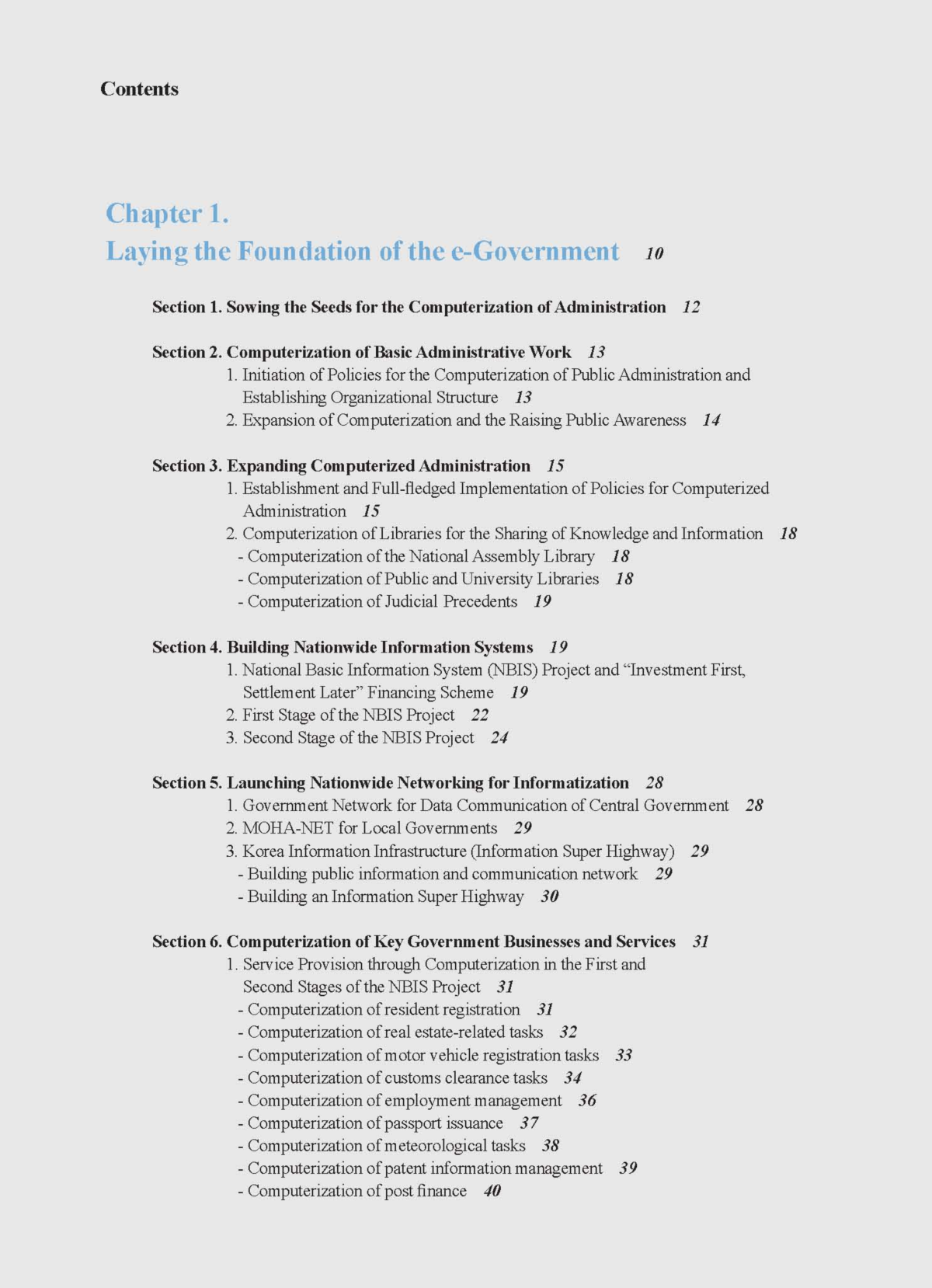
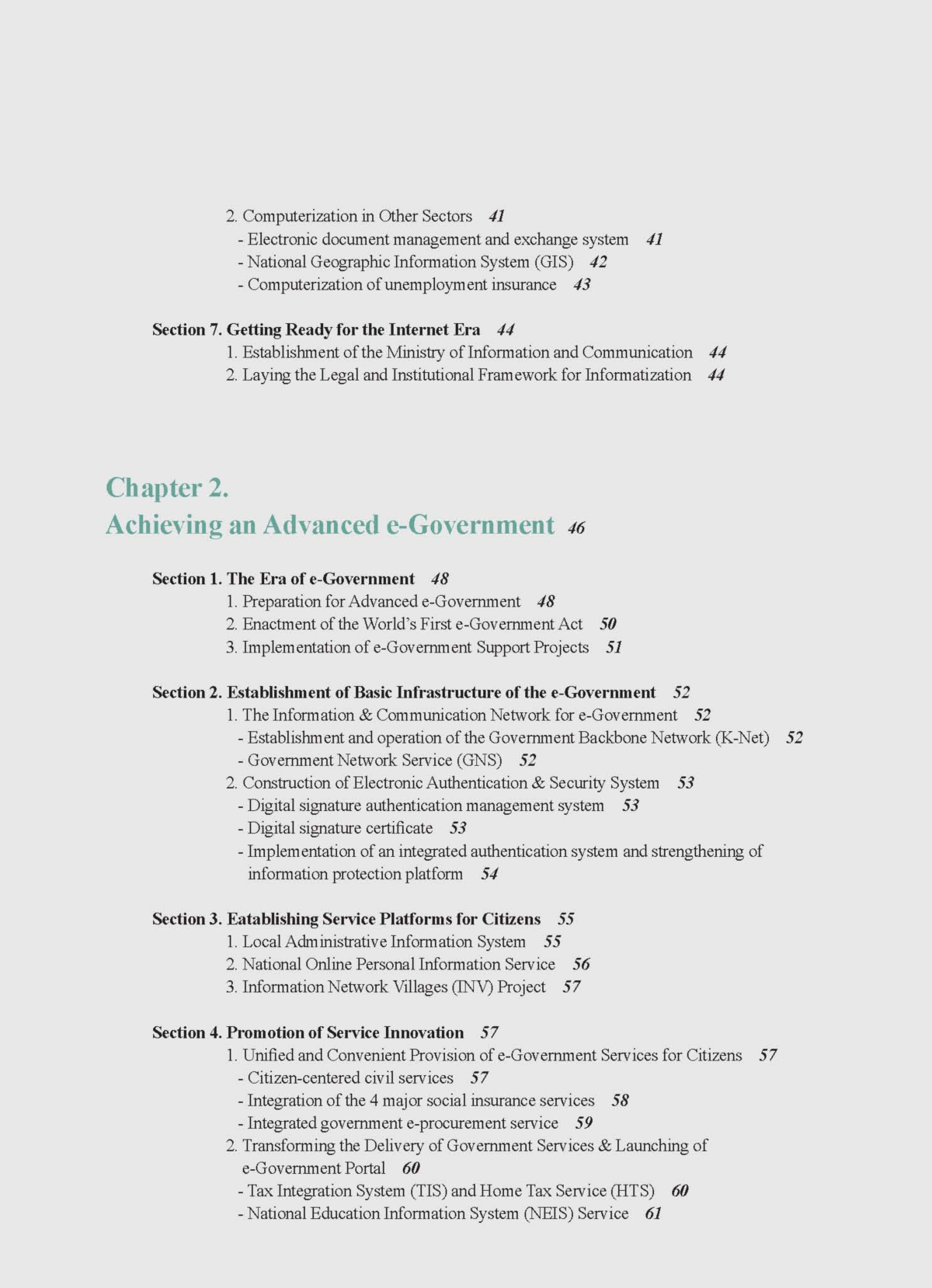
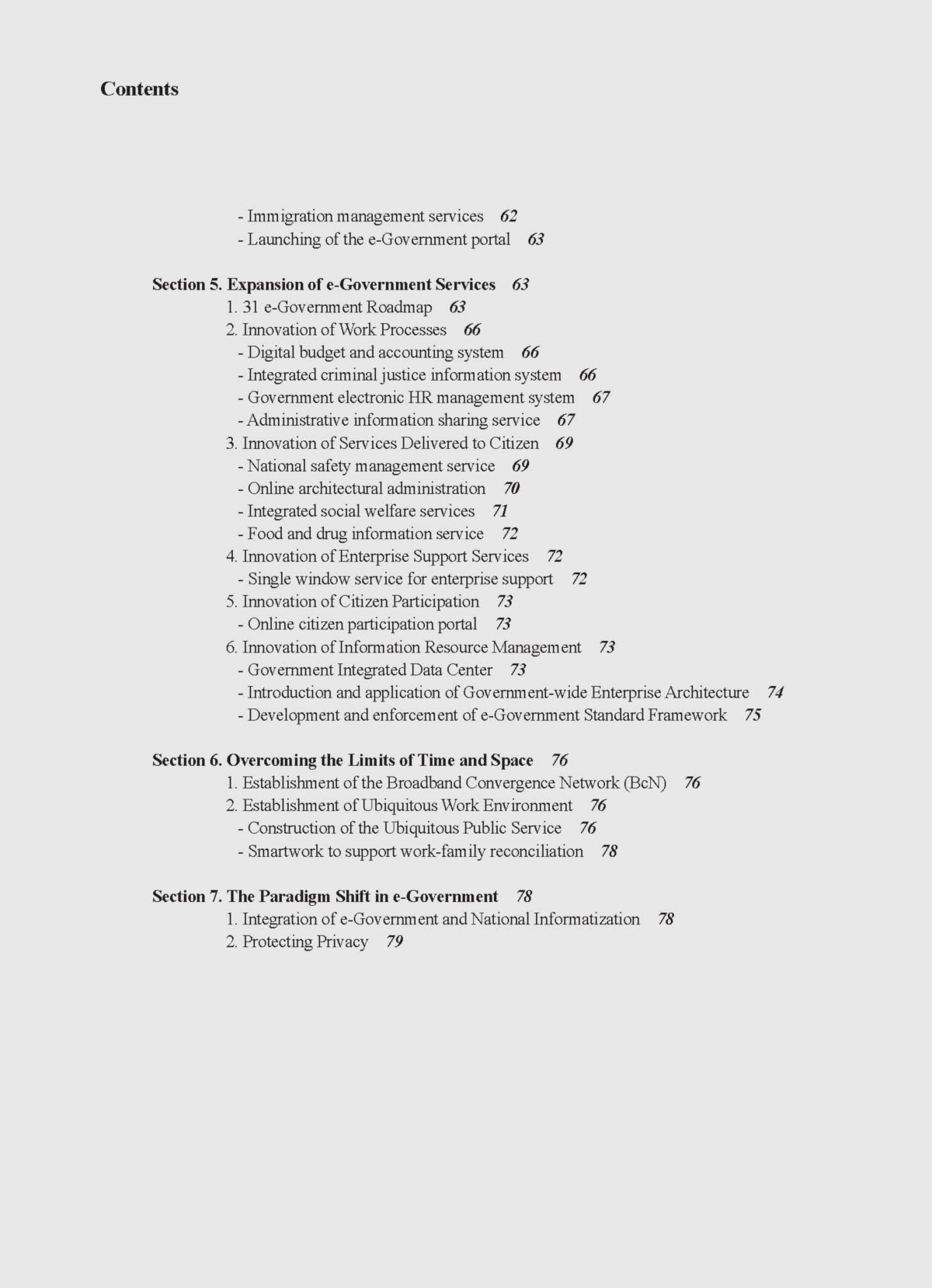
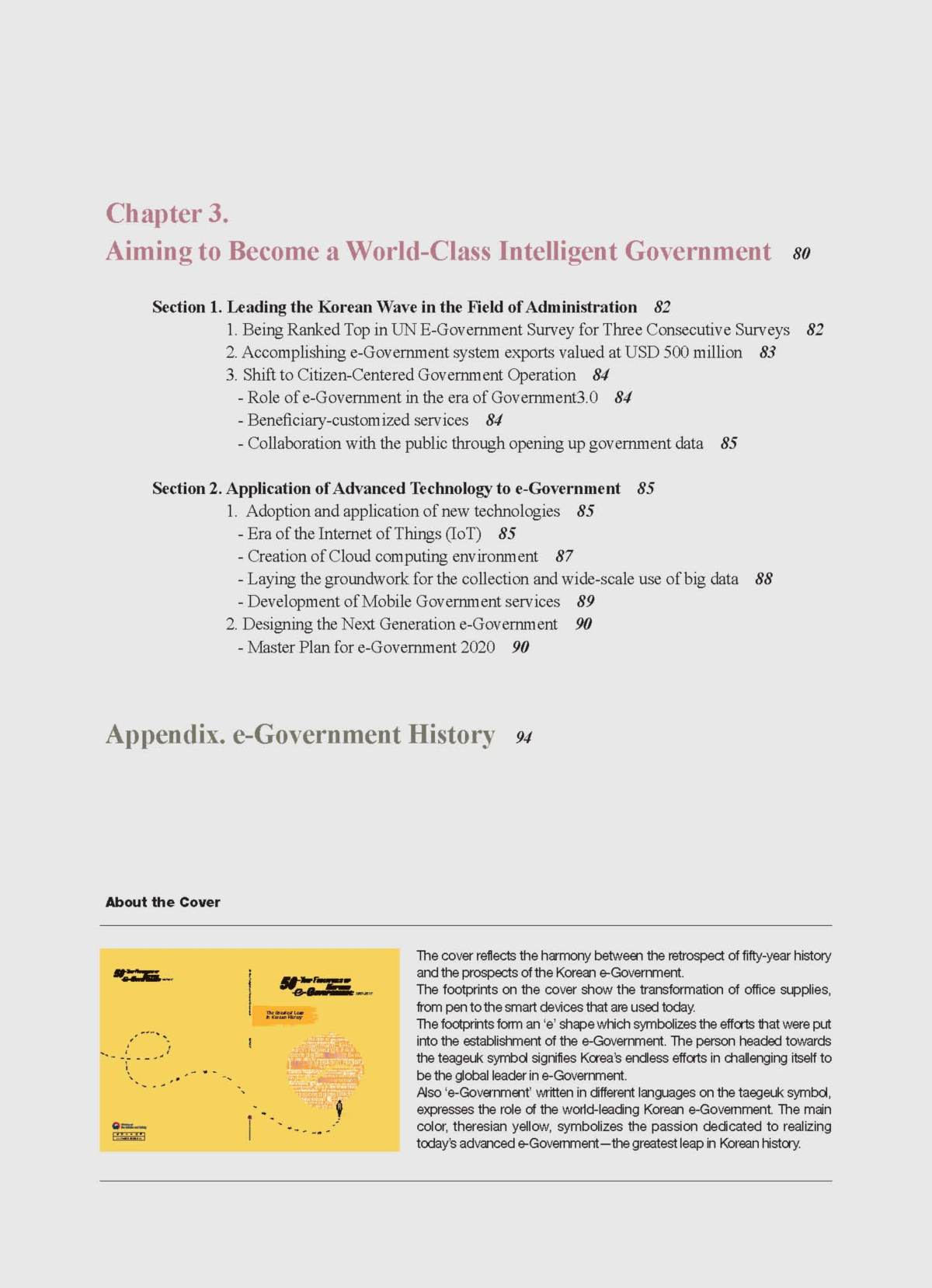
Contents Chapter 1. Laying the Foundation of the e-Government 10 Section 1. Sowing the Seeds for the Computerization of Administration 12 Section 2. Computerization of Basic Administrative Work 13 1. Initiation of Policies for the Computerization of Public Administration and Establishing Organizational Structure 13 2. Expansion of Computerization and the Raising Public Awareness 14 Section 3. Expanding Computerized Administration 15 1. Establishment and Full-fledged Implementation of Policies for Computerized Administration 15 2. Computerization of Libraries for the Sharing of Knowledge and Information 18 - Computerization of the National Assembly Library 18 - Computerization of public and university libraries 18 - Computerization of judicial precedents 19 Section 4. Building Nationwide Information Systems 19 1. National Basic Information System (NBIS) Project and “Investment first, Settlement Later” Financing Scheme 19 2. First Stage of the NBIS Project 22 3. Second Stage of the NBIS Project 24 Section 5. Launching Nationwide Networking for Informatization 28 1. Government Network for Data Communication of Central Government 28 2. MOHA-NET for Local Governments 29 3. Korea Information Infrastructure (Information Super Highway) 29 - Building public information and communication network 29 - Building an information super highway 30 Section 6. Computerization of Key Government Businesses and Services 31 1. Service Provision through Computerization in the First and Second Stages of the NBIS Project 31 - Computerization of resident registration 31 - Computerization of real estate-related tasks 32 - Computerization of motor vehicle registration tasks 33 - Computerization of customs clearance tasks 34 - Computerization of employment management 36 - Computerization of passport issuance 37 - Computerization of meteorological tasks 38 - Computerization of patent information management 39 - Computerization of post finance 40 2. Computerization in Other Sectors 41 - Electronic document management and exchange system 41 - National Geographic Information System (GIS) 42 - Computerization of unemployment insurance 43 Section 7. Getting Ready for the Internet Era 44 1. Establishment of the Ministry of Information and Communication 44 2. Laying the Legal and Institutional Framework for Informatization 44 Chapter 2. Achieving an Advanced e-Government 46 Section 1. The Era of e-Government 48 1. Preparation for Advanced e-Government 48 2. Enactment of the World’s First e-Government Act 50 3. Implementation of e-Government Support Projects 51 Section 2. Establishment of Basic Infrastructure of the e-Government 52 1. The Information & Communication Network for e-Government 52 - Establishment and operation of the Government Backbone Network (K-Net) 52 - Government Network Service (GNS) 52 2. Construction of Electronic Authentication & Security System 53 - Digital signature authentication management system 53 - Digital signature certificate 53 - Implementation of an integrated authentication system and strengthening of information protection platform 54 Section 3. Eatablishing Service Platforms for Citizens 55 1. Local Administrative Information System 55 2. National Online Personal Information Service 56 3. Information Network Villages (INV) Project 57 Section 4. Promotion of Service Innovation 57 1. Unified and Convenient Provision of e-Government Services for Citizens 57 - Citizen-centered civil services 57 - Integration of the 4 major social insurance services 58 - Integrated government e-procurement service 59 2. Transforming the Delivery of Government Services & Launching of e-Government Portal 60 - Tax Integration System (TIS) and Home Tax Service (HTS) 60 - National Education Information System (NEIS) Service 61 - Immigration management services 62 - Launching of the e-Government portal 63 Section 5. Expansion of e-Government Services 63 1. 31 e-Government Roadmap 63 2. Innovation of Work Processes 66 - Digital budget and accounting system 66 - Integrated criminal justice information system 66 - Government electronic HR management system 67 - Administrative information sharing service 67 3. Innovation of Services Delivered to Citizen 69 - National safety management service 69 - Online architectural administration 70 - Integrated social welfare services 71 - Food and drug information service 72 4. Innovation of Enterprise Support Services 72 - Single window service for enterprise support 72 5. Innovation of Citizen Participation 73 - Online citizen participation portal 73 6. Innovation of Information Resource Management 73 - Government Integrated Data Center 73 - Introduction and application of Government-wide Enterprise Architecture 74 - Development and enforcement of e-Government Standard Framework 75 Section 6. Overcoming the Limits of Time and Space 76 1. Establishment of the Broadband Convergence Network (BcN) 76 2. Establishment of Ubiquitous Work Environment 76 - Construction of the Ubiquitous Public Service 76 - Smartwork to support work-family reconciliation 78 Section 7. The Paradigm Shift in e-Government 78 1. Integration of e-Government and National Informatization 78 2. Protecting Privacy 79 Chapter 3. Aiming to Become a World-Class Intelligent Government 80 Section 1. Leading the Korean Wave in the Field of Administration 82 1. Being Ranked Top in UN E-Government Survey for Three Consecutive Surveys 82 2. Accomplishing e-Government system exports valued at USD 500 million 83 3. Shift to Citizen-Centered Government Operation 84 - Role of e-Government in the era of Government3.0 84 - Beneficiary-customized services 84 - Collaboration with the public through opening up government data 85 Section 2. Application of Advanced Technology to e-Government 85 1. Adoption and application of new technologies 85 - Era of the Internet of Things (IoT) 85 - Creation of Cloud computing environment 87 - Laying the groundwork for the collection and wide-scale use of big data 88 - Development of Mobile Government services 89 2. Designing the Next Generation e-Government 90 - Master Plan for e-Government 2020 90 Appendix. e-Government History 94 About the Cover The cover reflects the harmony between the retrospect of fifty-year history and the prospects of the Korean e-Government. The footprints on the cover show the transformation of office supplies, from pen to the smart devices that are used today. The footprints form an ‘e’ shape which symbolizes the efforts that were put into the establishment of the e-Government. The person headed towards the teageuk symbol signifies Korea’s endless efforts in challenging itself to be the global leader in e-Government. Also ‘e-Government’ written in different languages on the taegeuk symbol, expresses the role of the world-leading Korean e-Government. The main color, theresian yellow, symbolizes the passion dedicated to realizing today’s advanced e-Government—the greatest leap in Korean history.