NIA President Participates in the Broadband Commission’s 6th Meeting in New York
NIA President Participates in the Broadband Commission’s 6th Meeting in New York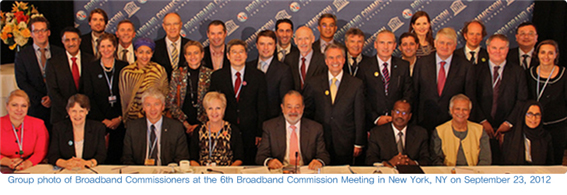
On September 23, 2012 in New York, NIA president and Broadband Commissioner, Dr. Seang-Tae Kim took part in the Broadband Commission’s 6th meeting that coincided with the 67th session of the UN General Assembly.
During the meeting, the Broadband Commission for Digital Development released its first-ever country-by-country snapshot of the state of broadband deployment worldwide. The report titled, “The State of Broadband 2012: Achieving Digital Inclusion for All” evaluates the roll-out of broadband around the world and tracks progress towards achieving the four advocacy targets set by the Commission in 2011 for boosting broadband affordability and uptake. It provides country rankings across up to 177 economies on economic impact, penetration, national broadband policy, and connecting people and dwellings.It was welcomed by UN Secretary-General Ban Ki-moon, who called broadband, “a transformative technology that has the potential to spark advances across all three pillars of sustainable development: economic prosperity, social inclusion and environmental sustainability.”
The State of Broadband 2012 report draws on ITU’s extensive statistical evidence base and is the result of close collaboration between Broadband Commissioners. Based on interviews, contributions and supporting material from more than 20 experts and their organizations, it highlights the importance of public private partnerships in accelerating change, presents twelve recommendations from the Commission to speed up the roll-out and deployment of broadband to accelerate progress towards achieving the Millennium Development Goals (MDGs), and includes 24 ‘featured insights’ from the Commission, which comprises 60 leaders from industry, government, international organizations and NGOs.
One other significant note at the Broadband Commission’s meeting was the involvement and call to action by Academy Award-winning actor and advocate, Geena Davis who called on the Commission to set up new working group on Broadband and Gender.
Ms Davis appealed to the Commission to set up a special focus group on gender that would undertake research on the many ways broadband networks and technologies could be used to empower girls and women - for example, through access to education, health care and useful information such as farming advice, climate monitoring and commodity prices, but also as tools to foster female entrepreneurship and new business opportunities.
“Broadband is having a transformational impact on the media and entertainment industry, but its importance reaches much further than that - Broadband will be key to meeting the Millennium Development Goals, providing women with the means to educate themselves and their children; improve their own health and the health of their families and communities; start their own businesses; keep themselves safe; and innovate to build and shape the future they want. This Commission can play a powerful advocacy role by speaking out strongly for the greater engagement of girls and women in the digital revolution taking place all around us,” said Ms. Davis.
In total, around 40 Broadband Commissioners took part in the meeting and agreed to continue to work together to advocate widespread use of broadband around the world.