Korea Successfully Hosts Global e-Government Forum in Seoul
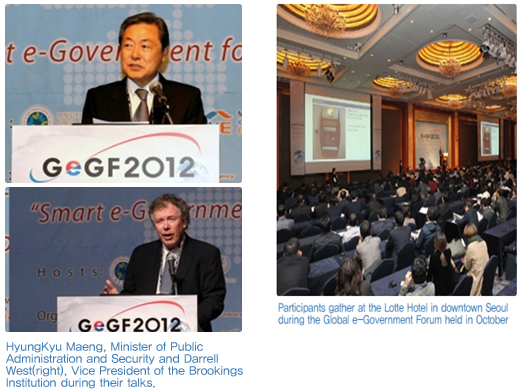
Korea Successfully Hosts Global e-Government Forum in SeoulKorea’s Ministry of Public Administration and Security hosted the Global e-Government Forum 2012 that took place October 18 - 19 at the Lotte Hotel in Seoul, Korea. Global leaders such as ministers and vice-ministers from 19 countries were in attendance, including representatives of Sweden, Romania, Ukraine, Indonesia, Vietnam, Iran, Bahrain, and Ghana. Also in attendance were more than 700 specialists from International organizations, universities, and IT companies from 50 countries. The forum was co-hosted by the United Nations, the Ministry of Public Administration and Security (MOPAS), and the Ministry of Knowledge Economy (MKE). In addition the Forum was organized in part by NIA, NIPA, KAPA and ITSA.
Recognizing e-Government as a key tool for improving the quality of life of citizens and enhancing national competiveness, governments around the world have implemented e-government as a core national agenda to successfully innovate in public services and better serve citizens in their respective countries. The Forum provided a venue to share these core values of e-Government, and build a strong global cooperation network, contributing to the streamlining of smart e-government at the global level for a better future.
Darrell West, the Vice President of the Brookings Institution, kicked off the forum with a keynote speech, saying that, “The world now has many challenges to address in various areas - economic development, health care, and education - and technological innovation can be utilized to deal with the social and economic issues.
HyungKyu Maeng, Minister of Public Administration and Security, said in the opening ceremony, “The advancement of e-government has brought about the changes for both individuals and the government. The government has become more democratic and transparent while citizens are able to use administration services more conveniently anytime and anywhere. However, not all countries seem to enjoy the benefits of the technology due to infrastructure gaps." For this, he believes that international society should help each other and share their experiences.
The Global e-Government Forum was comprised of three tracks: government, business & academic sector, and international organization. In the government track, under the theme of ‘e-Government Best Practices and Development Strategies’, high-ranking officials from 19 countries including Kalamullah Ramli, Senior Advisor to the Minister, Ministry of Communication and Information Technology, Indonesia, and Nguyen Minh Hong, Deputy Minister, Ministry of Information and Communications, Vietnam attended and gave presentations regarding the best practices of e-government. In the business & academic track, under the topic of ‘Social, Technical Changes and e-Government’, IT specialists from United Nations University, IBM, LG and KT introduced new technologies related to mobile, big data, and cloud computing.
On the second day, Seoul communique was adopted at the high-level round table where twenty ministers and vice-ministers including those from Korea, Panama, Romania, Cameroon, Ukraine, and CIS attended. The aim was to demonstrate that e-government should enable a transparent and efficient work process, and help the citizens participate in the policy-making process, ultimately making the life of mankind more convenient and contributing to enhancing democracy. The communique referenced that the participant countries should put an effort into building an international cooperation network through which they can share experiences and knowledge of e-government, as well as bridging the global digital divide by supporting and developing less-developed countries. As a follow-up, the leaders agreed to hold the forum every year, and organize a ‘Global CIO Network’ among participant nations and international organizations.